

Current Research
“Yesteryear and the Rise of Trad Wife Fiction”

Currently, I am preparing a Just-in-Time session for the 2027 MLA conference. If accepted, this panel will analyze the recent slew of literary and genre fiction about “trad wives,” particularly Caro Claire Burke’s novel Yesteryear.
“The Rise of Chick Schlock: Feminist Horror Novels in the United States’ Rightward Turn”
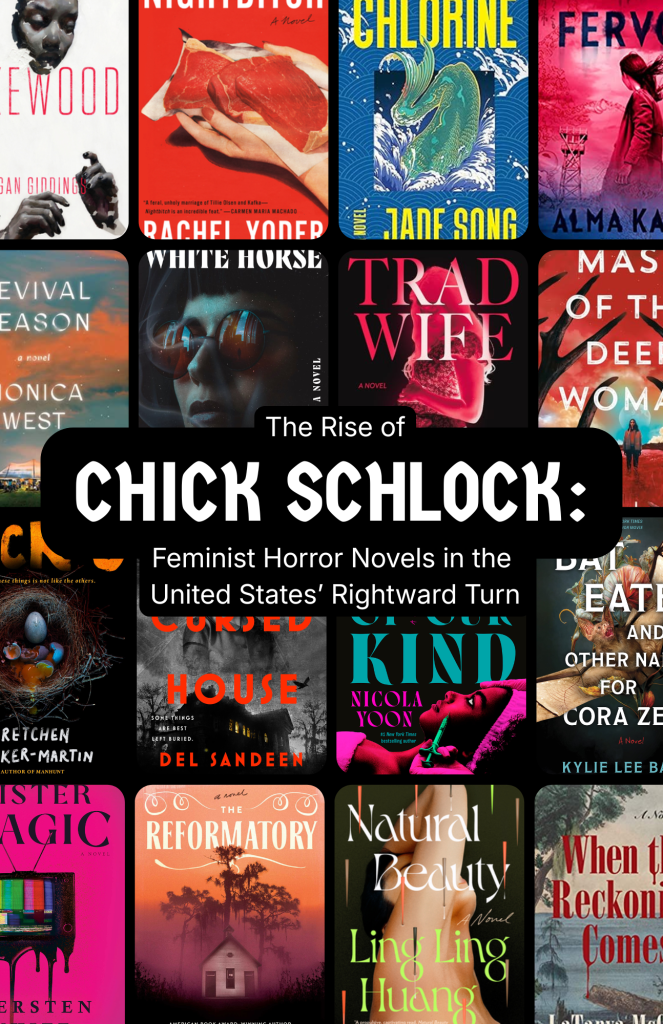
This article examines how women living in the United States respond to the country’s increasingly authoritarian landscape through contemporary horror novels. Defining these novels as “chick schlock,” this study borrows from American cultural studies, Gothic studies, and feminist theory to identify common cultural functions across sixteen primary texts.
This article is under review for a special issue of Women’s Studies (titled “Haunting Revisions: The Female Gothic Across Time and Media”), edited by Dr. Cynthia Murillo and Dr. Jennifer Nader.
“The Shining as Ecohorror”

Co-authored with Dr. Matt Morgenstern, this chapter provides the first dedicated reading of The Shining as a work of ecohorror through a focus on its naturally occurring and man-made environments.
This chapter will appear in the collection 50 Years of The Shining, edited by Dr. Jeffrey Andrew Weinstock and Dr. Tony Magistrale (University of Mississippi Press, 2027).
Dissertation Abstract
Spaces of Assimilation: Multiethnic American Women’s Writing and the Gothic analyzes how minority and immigrant women writers employ Gothic tropes to narrate the pressures of assimilation into Protestant Anglo-American culture throughout the late nineteenth and early twentieth centuries. A multifaceted feminist literary recovery project, my dissertation uses tools and techniques from literary studies, Gothic studies, feminist studies, and American cultural studies to trace the Gothic through underrepresented women’s otherwise autobiographical, realist, and modernist writings.
My dissertation examines recurring Gothic tropes (including, for example, the uncanny, doubles, hauntings, and monsters) throughout Dakota Sioux author Zitkala-Ša’s American Indian Stories (chapter 1); African American writer Angelina Weld Grimké’s “The Closing Door” and “Goldie” (chapter 2); Jewish Eastern European immigrants Yente Serdatsky’s “Unchanged” as well as Anzia Yezierska’s “Wings” and “Hunger” (chapter 3), and Asian American immigrant Sui Sin Far’s “The Gambler” and “Mrs. Spring Fragrance,” among others (chapter 4). I argue that these writers use the Indigenous and Native American Gothic, African American Gothic, Jewish American Gothic, and Asian American Gothic, respectively, to narrate their experiences with forced assimilation in various cultural, literary, and physical spaces. From West Coast Chinatowns to Lower East Side tenements, these spaces of assimilation prompt writers to express anxieties about instruments of Anglo-American cultural imperialism, such as education, progressive eugenics, labor, housing, and material culture, using Gothic conventions. Exploring echoes of these Progressive-Era Gothic writings more than a century later, the coda analyzes contemporary minority and immigrant women writers’ horror novels by Erika T. Wurth, Tananarive Due, and Alma Katsu, among others. This dissertation traces Gothic tropes to emphasize the systemic—and often horrific—nature of forced assimilation and its insistence on linguistic, religious, and ethnocultural hegemony. From the nineteenth to the twenty-first centuries, these stories narrate historically marginalized women writers’ profound skepticism about what it means to be or become “American.”

